Articles Posted in Board-and-Care

inhomeAt Nursing Home Law Group, we represent individuals and families in cases of neglect and abuse in nursing homes and assisted living facilities throughout California. For more than twenty five years, our practice has focused on protecting vulnerable elders and holding facilities accountable when they fail to provide safe, appropriate care.

For many years, hospice rarely played a role in the cases we handled. That has changed dramatically.

Today, hospice providers are involved in nearly half of our nursing home and assisted living cases. Often they are not named as defendants. But their involvement frequently creates confusion, delays, and missed opportunities to provide life saving care. In some cases, hospice status becomes the very reason a resident does not receive emergency treatment at all.

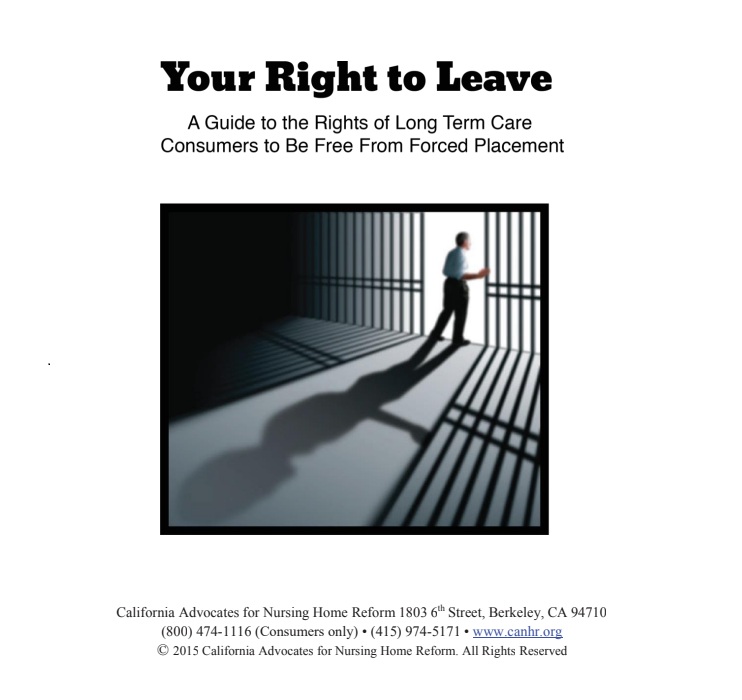
CANHR-300x283Is there any right more fundamental than the freedom to leave a place where you do not wish to stay? For nursing home residents in California, this right is often disregarded—sometimes in direct violation of the law. Fortunately, the California Advocates for Nursing Home Reform (CANHR) has recently updated its guide for long-term care residents who are being held against their will. This guide outlines the legal protections available and provides practical steps to challenge illegal restrictions on a resident’s right to leave.

The Right to Move Freely

Imagine you live independently in an apartment, making your own choices and living life on your own terms. One day, your landlord locks you inside, installs alarms on your doors and windows, and tells you that you’re not allowed to leave. He insists that, for your own safety, you must remain inside indefinitely. When you call the police for help, they tell you that your situation is a “civil matter” and that you need a court order to be able to leave.

handsOne of the largest nursing homes in Stockton, CA is facing numerous allegations of nursing home abuse and neglect, according to a recent article from Recordnet.com. Reports from patients and their families allege lack of privacy, physical abuse, and serious neglect at Wagner Heights Nursing and Rehabilitation Center. What else do you need to know about these allegations? Can they help families to understand the importance of researching a nursing home or assisted-living facility before allowing an elderly loved one to become a resident at a facility without the best patient ratings?

Serious Citations at Wagner Heights Nursing and Rehabilitation Center

Based on data provided by California Advocates for Nursing Home Reform (CANHR), Wagner “has been issued the greatest number of serious citations going back to 2010 . . . of any skilled nursing home in Stockton.” Over the last six years, it has received six serious citations. Why were those citations issued? According to the article, the following represent some of the most serious fines levied against Wagner Heights:

apartment buildingWhen we read news stories or hear anecdotes about elder abuse and neglect in San Diego, we often thinking about harms that occur in nursing homes, assisted-living facilities, and residential care facilities for the elderly (RCFEs). In other words, we consider the risks our elderly loved one face in facilities that are required to be licensed by the state of California. When injuries do occur at these regulated places, we should consider the ways in which the California Department of Public Health might be responsible.

But what happens when an older adult sustains elder abuse injuries at a boarding home—a type of residence that does not have to be licensed or certified by the state? A recent article in the San Jose Mercury News discussed the rising number of boarding homes for seniors in California and the ways in which these residences could be the most dangerous of all.

Initial Financial Benefits of Boarding Homes

At Walton Law Firm, we have handled numerous cases involving decubitus ulcers or bed sores, many of them resulting in the death of the patient. But the cases we handle are civil cases; a prosecution of the nursing home or other caregiver to seek money damages. We have never seen any caregiver prosecuted criminally for such neglect.

090903_jean_rudolph.jpgIn Washington State, however, the owner of an assisted living facility and an employee were charged with crimes for the neglect of Jean Rudolph, who died under their care. When Rudolph died in 2008 at the age of 87, she weighed only 68 pounds. The cause of death was related to infections that were caused by bed sores so severe that they exposed her bones, including a hip sore so severe that her hip bone jutted out of her body.

Her son, who visited her twice a week, never knew of the sores. His mother suffered from end-stage dementia and couldn’t speak or express her needs, and each time the son visited she was always under covers.

A 72-year-old woman suffered burns on her hands and feet while under the care of an Escondido woman and her son at their home-based elder care facility. Mila Labayen, 74, and her son, Steve Perez Lopez, 50, face criminal charges for elder abuse arising from their failure to seek immediate medical attention for the injuries of the resident who suffers from dementia. In addition, Mr. Lopez is charged with draining $45,000 from the bank account of another elderly resident, who suffers from schizophrenia. Mr. Lopez allegedly took the money while out on bail for charges relating to the elder abuse claim. Alert bank employees alerted authorities to the suspicious withdrawal of money.

It is unclear what caused the 72-year-old woman’s burns, but by the time her daughter learned of her injuries and brought her to the hospital, her skin was already sloughing off, and she remained in the hospital’s burn unit for nine days.

The elder care home, Liberty Care Homes III, located on the 1100 block of Via Rancho Parkway, was owned and operated by Ms. Labayan and was licensed to provide residential care for up to six elderly people. The license was first issued in 1993. Liberty Care Homes III is now closed.

A former aide at a home for the disabled has been arrested and charged with molesting two female residents. Curtis Cortez, age 59, is being held on $100,000 bail after his arrest, and is expected to be charged with seven felony counts of lewd and lascivious actions by a caretaker upon a dependent person.

From news accounts, it appears the man has confessed his crimes to police, at least partially. When police confronted Curtis about the allegations, he offered a “Hawaiian defense.” He told authorities that he gave frequent hugs to people because it was part of his Hawaiian culture. He then volunteered that he was having problems with his girlfriend, and that he did touch one of the disabled woman’s breasts and genitals.

From a civil liability standpoint it is an interesting case. Curtis himself would obviously be liable for sexual assault and battery, but probably unable to pay a civil judgment. The question is, would the home be liable? Generally speaking, an employer is not liable for the intentional criminal acts of its employees, unless the acts were engendered by, or arose out, the employee’s duties. This one would be a close call.

A few times a year we hear news stories of Alzheimer’s sufferers wandering away from their homes and becoming lost. Those stories end one of two ways, and unfortunately, too often the ending is not a happy one.

These sad stories have created a cottage industry for nursing home providers. We have all now heard of nursing homes advertising themselves with “special neighborhoods for the memory impaired.” Or providing “safe and secure” housing for the Alzheimer’s patient. But what happens when the victim wanders away from those facilities?

A few years ago, such a thing happened in Escondido. Then a 94-year-old woman walked out of Palomar Heights Care Center in Escondido and into the path of a car, killing her instantly. Caregivers told the media that they didn’t know what happened, but a subsequent lawsuit revealed some serious neglect on the part of the home.

Nursing-Home-001-200x300An investigation that began as a routine police search for a 23-year-old man quickly uncovered a shocking scene of systemic neglect and abuse at an unlicensed board-and-care facility in San Bernardino. When authorities arrived at the property to locate Trevor Castro, they were instead confronted with a horrific living environment that led to the immediate arrest of the home’s owner, 61-year-old Pensri Sophar Dalton. Dalton, known to residents as “Mama Sophar,” now faces 16 felony counts of elder abuse as investigators unravel the full scope of her operations.

The conditions discovered inside the facility were described by officials as outright squalor. Before even stepping foot inside the main structure, responding officers encountered a bucket of human urine left outside the front door. The interior of the property revealed a heavily fortified, prison-like compound. The entire home was surrounded by high cinderblock walls topped with barbed wire. Far from providing a safe, therapeutic environment for the 22 elderly and mentally ill residents living there, the facility appeared designed to trap and isolate its vulnerable occupants.

Most alarming to investigators was the discovery that several residents were being housed in converted chicken coops. These makeshift structures lacked basic amenities, including indoor plumbing, forcing residents to use a single bucket as a toilet. San Bernardino City Attorney James Penman noted that none of the residential structures on the property came close to meeting basic building or safety codes. Furthermore, several of the modified rooms featured heavy padlocks affixed to the outside of the doors with absolutely no emergency exits available from the inside. Penman expressed grave concern over this setup, noting that the locks were clearly capable of trapping residents inside a dangerous, unventilated space. The physical neglect was compounded by an overwhelming, pervasive odor of urine that permeated the entire property.

Contact Information